Engineering Operations Intelligence
An evidence-linked workflow that prepares review context, runs repeatable checks, and keeps merge and release authority with engineers.
System pattern
The operating surface, not a chatbot.
Implementation blueprint informed by delivery capabilities and third-party workflow references.
Problem
Reviewers lose time rebuilding task, code, CI, runtime, and ownership context across disconnected tools.
First wedge
Begin with review preparation for one repository group in read-only, recommendation mode.
Workflow shift
Move from fragmented coordination to a controlled operating loop.
Current state
- 01
Requests arrive through issues, chat, alerts, or product work.
- 02
Engineers rebuild context from code, docs, CI, and runtime signals.
- 03
PRs reach review with uneven evidence, risk labels, and ownership context.
- 04
Rejected changes and incidents rarely become reusable evaluation inputs.
Target state
- 01
Normalize intake into a task contract with owner, risk, evidence, and acceptance checks.
- 02
Retrieve approved code, planning, CI, and runtime context through scoped connectors.
- 03
Run deterministic completeness, ownership, test, and freshness checks.
- 04
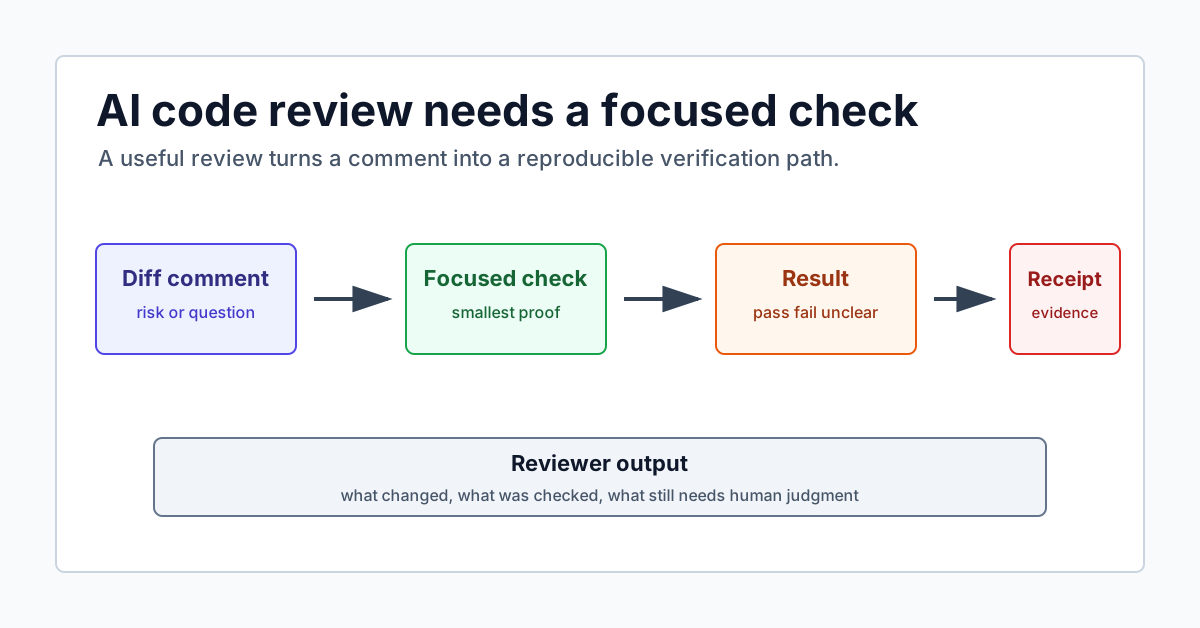
Draft an evidence-linked review brief and route high-risk work to human triage.
- 05
Keep merge and deploy decisions in native systems while capturing adjudicated outcomes.
Automation boundary
Use the least complicated mechanism that can safely own the step.
Deterministic
Parse CI, enforce policy checks, route ownership, and retain audit records.
Model
Summarize bounded context, surface missing evidence, and propose review questions.
Human
Judge quality, set priority, approve merge or deploy, and adjudicate evaluation labels.
FDE delivery loop
Earn autonomy through evidence.
- 01
Audit
Map review, release, incident, permissions, and ownership bottlenecks.
- 02
Build
Ship task contracts, scoped connectors, policy checks, and review briefs.
- 03
Evaluate
Use redacted historical work to test completeness, precision, and safety.
- 04
Deploy
Introduce opt-in recommendations for one repository group and named reviewers.
- 05
Observe
Review quality, drift, incidents, and adoption before expanding scope.
Measurement
What has to move before the case earns a stronger claim.
- Time to assemble review-ready context.
- Reviewer rework caused by missing context.
- Precision of accepted findings.
- Unsupported assertions and high-severity false negatives.
Proof gate
Expand only after reviewers sign off on measured quality, evidence coverage, and human-controlled release authority.
Safe public claim: A blueprint for an evidence-linked engineering workflow, not a claim of autonomous review or a client-wide delivery outcome.
References