Workspace Buzz
A private workspace foundation for human and agent coordination with signed events, durable room context, and accountable handoffs.
System pattern
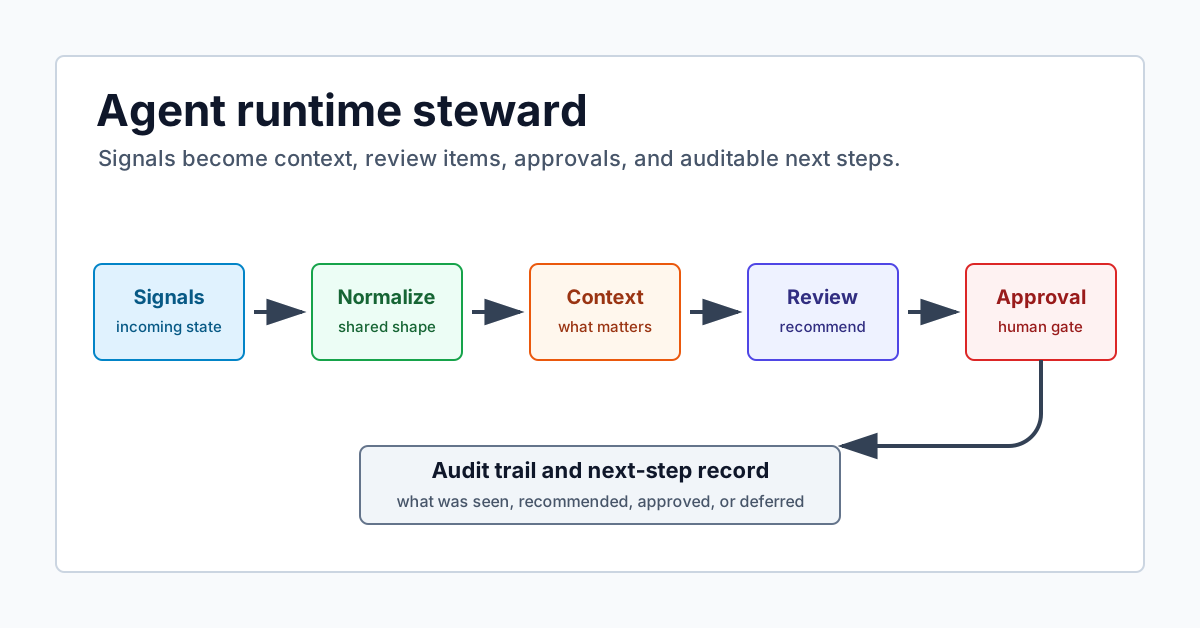
The operating surface, not a chatbot.
Verified implementation foundation. The supervised pilot and typed outcomes remain pending.
Problem
Operators need a private place to coordinate people and agents without losing ownership, context, or the evidence behind a decision.
First wedge
Start with one repeatable task in one operational room, then prove that a supervised loop improves re-entry and handoffs.
Workflow shift
Move from fragmented coordination to a controlled operating loop.
Current state
- 01
Work moves between chat, terminal sessions, and source systems.
- 02
A new operator must reconstruct the current owner, context, and next action.
- 03
Agent identity and room membership need explicit boundaries.
- 04
Historical records must stay in their source systems, not be copied into a new workspace.
Target state
- 01
Open one operational room with a named human owner.
- 02
Place one managed agent with a clear role and access boundary.
- 03
Run one bounded task in a thread with inputs and acceptance criteria.
- 04
Require human approval for consequential actions or exceptions.
- 05
Store a privacy-safe receipt and typed outcome outside the chat surface.
Automation boundary
Use the least complicated mechanism that can safely own the step.
Deterministic
Validate membership, retrieve signed events, preserve source links, and persist receipt IDs.
Model
Summarize context, classify work, and propose a plan with cited inputs.
Human
Approve placement and sensitive actions, resolve ambiguity, and own the final decision.
FDE delivery loop
Earn autonomy through evidence.
- 01
Audit
Choose one room, repeated task, operator, and source systems.
- 02
Build
Define the thread template, role boundary, receipt schema, and outcome record.
- 03
Evaluate
Run five supervised attempts and capture friction, controls, and handoff quality.
- 04
Deploy
Connect read-only inputs and make receipt pointers available to operators.
- 05
Observe
Review outcomes before expanding to another task or room.
Measurement
What has to move before the case earns a stronger claim.
- Time for a new operator to find owner, input, decision, and next action.
- Attempts with a complete receipt pointer and explicit next owner.
- Consequential actions approved by the required human.
- Operator choice to start the next comparable task in the room.
Proof gate
Five comparable supervised attempts must show useful handoffs and intact controls before wider adoption.
Safe public claim: Implemented a self-hosted coordination foundation; it is not presented as a production replacement for Slack, tmux, or a system of record.
References