Logistics Operations Intelligence
An auditable exception queue for shipment and inventory risk, designed around accountable operator action.
System pattern
The operating surface, not a chatbot.
A public-safe implementation blueprint for a bounded inbound-delay or allocation-risk workflow.
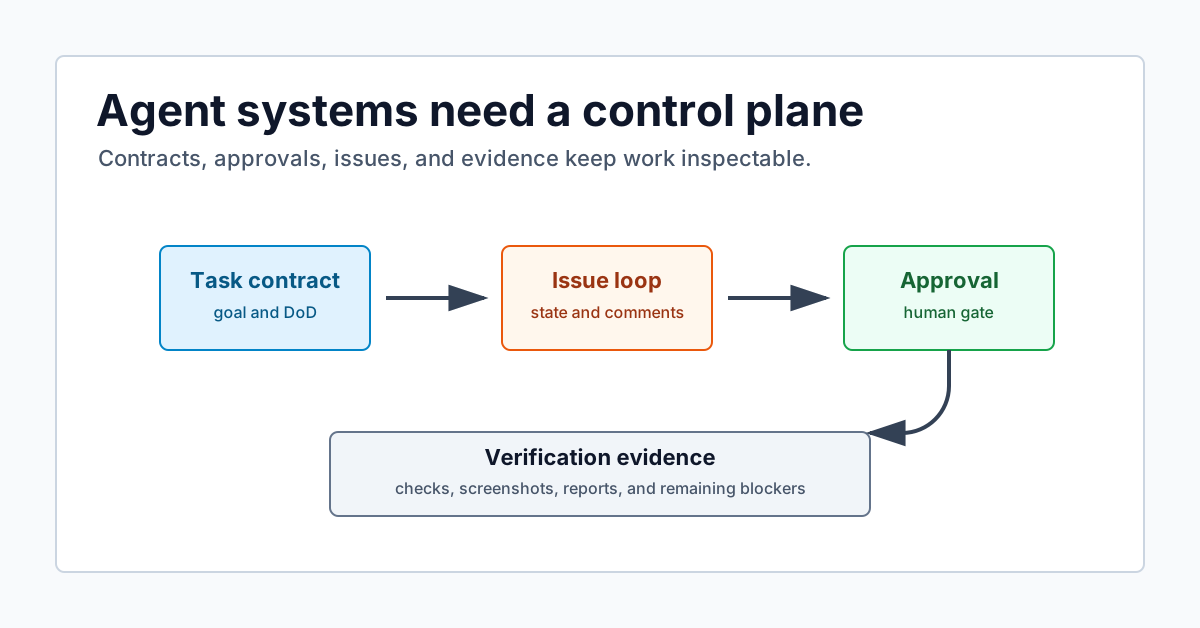
Problem
Coordinators rebuild shipment and inventory context across ERP, warehouse, carrier, spreadsheet, and chat systems.
First wedge
Start with one read-only inbound-delay or allocation-risk exception queue, not autonomous operations.
Workflow shift
Move from fragmented coordination to a controlled operating loop.
Current state
- 01
A shipment, inventory, or supplier signal appears in one operational system.
- 02
A coordinator gathers item, PO, allocation, ETA, and customer-impact context from several tools.
- 03
Missing facts and decisions move through chat, email, and a spreadsheet queue.
- 04
Follow-up and final outcomes are inconsistently connected to the original exception.
Target state
- 01
Approved source events enter a normalized exception ledger with timestamps and source links.
- 02
Deterministic checks deduplicate records and apply severity, ownership, and SLA rules.
- 03
Read-only enrichment adds approved inventory, PO, allocation, carrier, and demand context.
- 04
A model summarizes evidence, identifies missing data, and ranks options where coverage is sufficient.
- 05
An accountable operator approves external action and records the outcome against the exception.
Automation boundary
Use the least complicated mechanism that can safely own the step.
Deterministic
Validate schemas, source freshness, deduplication, severity, routing, SLA timers, and audit events.
Model
Summarize cited evidence, classify bounded exceptions, identify gaps, and draft options.
Human
Approve hold, release, reallocation, or escalation actions and adjudicate edge cases.
FDE delivery loop
Earn autonomy through evidence.
- 01
Audit
Shadow one review cycle and define a source map, taxonomy, decision matrix, and baseline.
- 02
Build
Ship a normalized exception schema, read-only connectors, policy engine, and escalation queue.
- 03
Evaluate
Replay historical exceptions to measure agreement, usefulness, corrections, and unsafe suggestions.
- 04
Deploy
Use shadow mode before recommendation-only operation for the selected reversible workflow.
- 05
Observe
Review false positives, stale context, overrides, source outages, and unresolved escalations.
Measurement
What has to move before the case earns a stronger claim.
- Context assembly time for the selected exception type.
- First-response SLA and unresolved exception aging.
- Evidence completeness and human correction rate.
- Unsafe-action escapes and reopened exception trends.
Proof gate
Promote only after named ownership, source access, a measured pilot baseline, and a deployment receipt.
Safe public claim: This is a proposed, human-approved logistics workflow. It does not claim a client deployment, supply-chain improvement, or ROI.
References