Decision records for AI agents
How lightweight decision records keep agent work recoverable without turning every chat into a source of truth.
Agentic teams generate a lot of text. Most of it should not become project memory.
That is the first rule. Without it, every chat summary, task recap, and agent handoff starts to look like a source of truth. The project becomes softer, not clearer. Old assumptions get repeated. Temporary workarounds look permanent. A later agent optimizes around a sentence that was never actually decided.
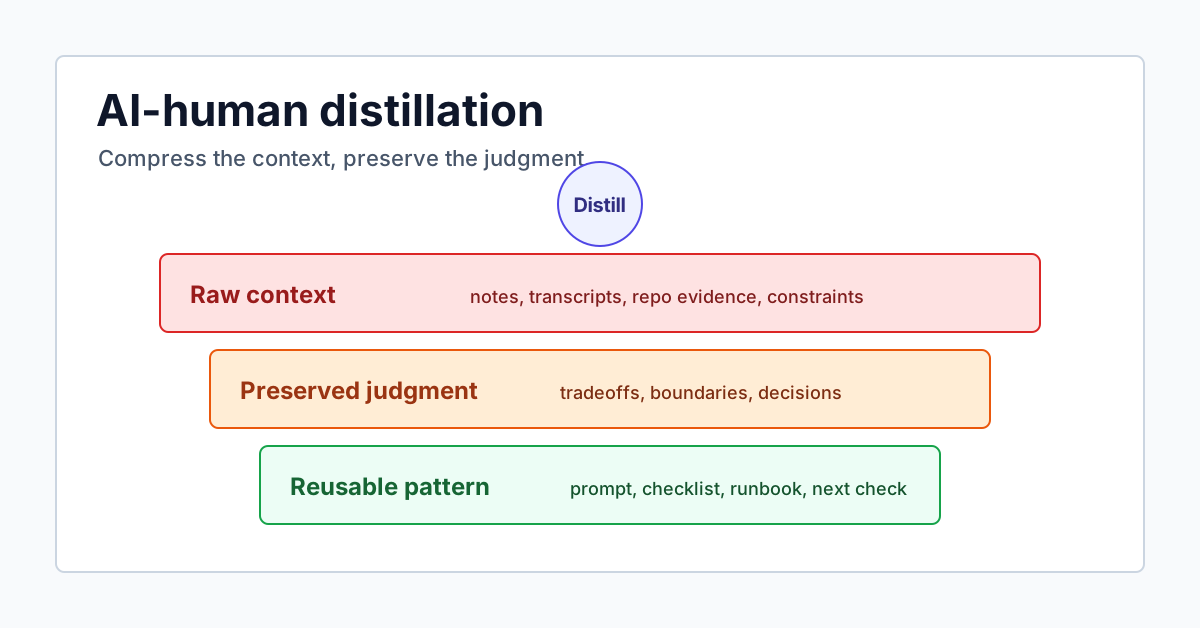
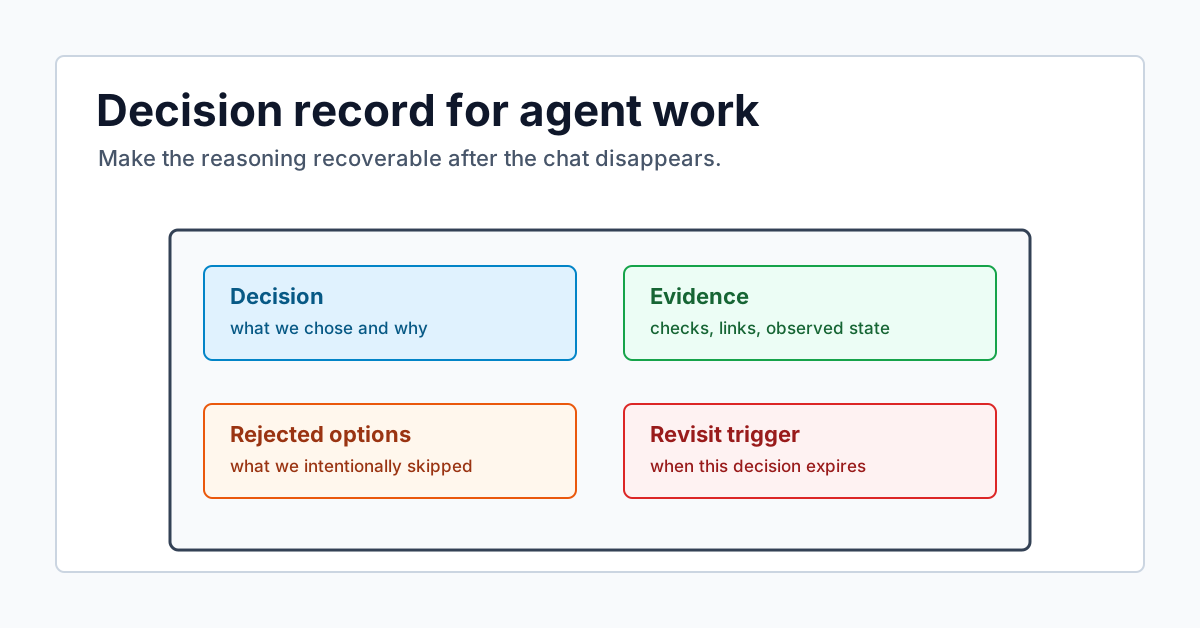
The answer is not more documentation for its own sake. The useful layer is a lightweight decision record: a small, durable note that says what was chosen, why it was chosen, what evidence mattered, and when the decision should be revisited.
For agentic work, this is less about classic architecture process and more about entropy control.
Why Prompts Are Not Enough
A prompt tells the current agent what to do. A decision record tells the next agent why the system is shaped this way.
That distinction becomes important when the same patterns repeat across repositories:
- when an agent must run a verification loop
- where task state lives
- which tracker is the source of truth and which surfaces are projections
- what counts as done
- when a browser or operator smoke test is required
- which GitOps rules are safe and which are forbidden
- which patterns worked once but should not be copied blindly
If those rules live only in a chat or in one operator’s memory, the next project imports the same uncertainty again. The agent may become too cautious, too confident, or simply wrong about which layer it should change.
A decision record gives that repeated pattern a handle.
The Minimum Useful Record
A useful record is small. It does not preserve the whole conversation. It captures the decision boundary.
At minimum it should answer:
- What did we decide?
- Why did we decide it now?
- What alternatives did we reject?
- What evidence or constraint mattered?
- Where is the implementation or proof?
- What would make us revisit it?
The last question is the one many records miss. Without a revisit trigger, decisions become dogma. With a revisit trigger, the record stays operational: “this is true while these assumptions hold.”
That is especially useful for agents because they are good at carrying old language forward. If the record says why the rule exists and when it expires, a future agent has a better chance of applying it correctly.
Chatter, Evidence, And The Handle
Conversations are evidence. They are not automatically the decision.
A transcript may show how the team explored options. A command log may show what was verified. A task note may show the acceptance criteria. Those artifacts are valuable, but they are too large and too noisy to become the thing every future agent reads first.
The decision record is the handle that points back to the evidence.
That handle should be boring and specific: a path, a commit, a test receipt, a design note, a task artifact, or a short explanation of the constraint. It should not ask a later human to reread an entire agent session just to understand whether a rule is real.
This matters because generated summaries can sound authoritative even when they compress away the uncertainty. A decision record should resist that by staying close to the evidence and by naming what was not decided.
Records For Agent Harnesses
In agent-heavy workflows, some of the most important decisions are not product architecture decisions. They are harness decisions.
Examples:
- the agent must close user-visible changes with browser or operator evidence
- a peer checkout may fast-forward only when clean, never reset automatically
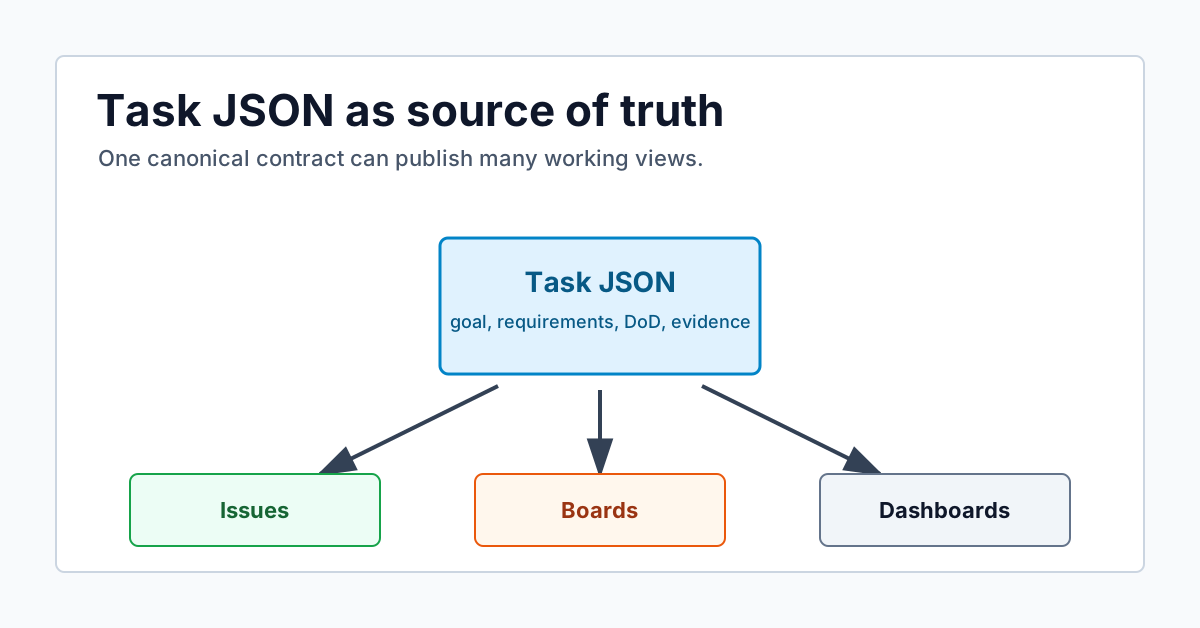
- task JSON is the execution record, while a board is only a projection
- secrets, raw transcripts, and private runtime state cannot be pasted into public artifacts
- a repeated verification failure must escalate the hypothesis instead of repeating blind patches
These are small rules, but they shape the quality of the whole delivery loop. If they remain implicit, every new agent has to rediscover them. If they are recorded, the system can continue with less operator friction.
The Goal
The goal is not bureaucracy. The goal is recoverability.
A new agent should be able to re-enter the work without rereading every transcript. A human should be able to challenge a decision without arguing against a wall of generated prose. A team should be able to tell the difference between a durable rule, a temporary workaround, and an unverified claim.
Decision records do not replace judgment. They make judgment easier to inspect later.
In an agentic SDLC, that is a practical reliability layer. Prompts create local behavior. Decision records preserve the reasons the behavior exists.
Reader next step
Keep reading before switching into hiring mode.
Related posts and tags are the natural continuation. About gives the profile context, and Projects has a few implementation notes.