Structured outputs are the API boundary of LLM products
LLM features become operable when prose is separated from typed output contracts, validation, retries, and refusal states.
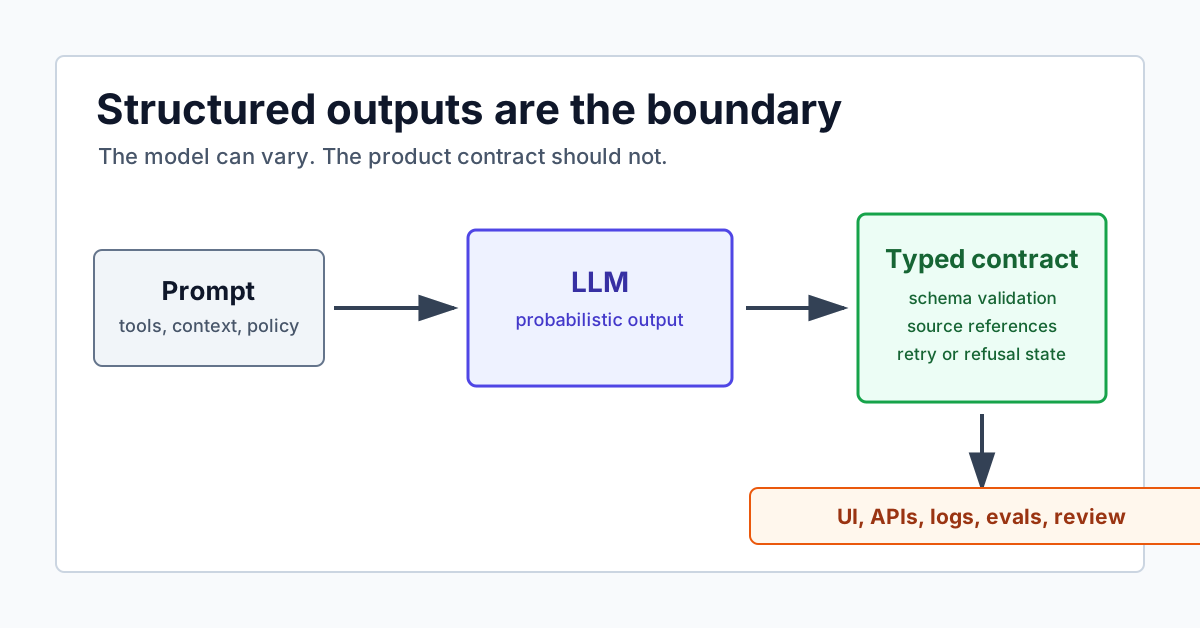
LLM product work gets easier to reason about when the model is not treated as the API.
The model is a reasoning and generation component. It can summarize, classify, extract, compare, plan, and explain. But the product still needs a stable boundary: fields, types, allowed states, failure modes, source references, and behavior that can be tested without reading a paragraph by hand.
That boundary is the structured output contract.
The point is not to make every interaction look like JSON. The point is to separate two concerns:
- the model can use language to reason through ambiguity;
- the product receives a typed object it can validate, render, store, evaluate, retry, or reject.
Without that separation, the downstream system has to parse prose. A UI tries to infer which line is the final answer. An API consumer tries to detect whether the model was uncertain. A log pipeline stores a blob that cannot be compared cleanly. A human reviewer has to guess whether missing evidence is a real absence or just omitted wording.
That is not a product boundary. That is a transcript.
The Contract
A useful output contract usually contains more than the happy-path answer.
It should describe the shape of the answer, but also the operational state around the answer:
- what kind of answer this is;
- which entities, records, or claims were found;
- which sources or inputs support each claim;
- what is missing;
- whether the model is confident enough to proceed;
- whether a retry is useful;
- whether the system should refuse, escalate, or return a partial result;
- which trace or run id connects the output to logs and evaluation.
The exact schema depends on the product. A search feature, compliance review, sales assistant, workflow agent, and support copilot should not share the same contract just because they all use an LLM. The contract should be designed around the next system that has to consume the answer.
For example, an answer product may need something like this:
{
  "answer_type": "comparison",
  "status": "partial",
  "findings": [
    {
      "claim": "Candidate A has direct platform operations experience.",
      "source_refs": ["doc:resume:platform-ops", "call:2026-05-12"],
      "confidence": "medium"
    }
  ],
  "missing_evidence": ["No direct production graph database ownership found."],
  "recommended_next_step": "Ask for a concrete architecture example.",
  "retryable": false,
  "trace_id": "run_20260527_structured_output_example"
}
The schema is not interesting because it is pretty. It is interesting because it gives every downstream layer a handle.
The UI can show “partial” differently from “complete.” The review queue can route medium-confidence claims. The logger can group failures by field. An evaluation can compare missing_evidence across runs. A human can challenge a specific claim instead of rereading an entire generated answer.
Validation Is Product Logic
Structured output is not finished when the model emits a valid-looking object.
There are at least two levels of validation.
The first level is shape validation: required fields, allowed enums, arrays where arrays are expected, valid dates, valid identifiers, and no extra fields if the boundary is strict. This catches the obvious failure mode: the model did not follow the contract.
The second level is semantic validation: do the source references exist, do cited records actually support the claim, does the confidence match the evidence policy, is the requested action allowed, did the model produce mutually inconsistent fields, and is the answer fresh enough for the decision?
Both levels matter. Shape validation protects the software boundary. Semantic validation protects the product boundary.
Retry logic should also be explicit. Some failures are worth retrying: malformed JSON, a missing required field, or an answer that ignored a recoverable instruction. Other failures should not be retried blindly: missing evidence, policy refusal, stale source data, or a request that the system is not allowed to satisfy.
If every failure becomes “try the prompt again,” the product hides uncertainty instead of managing it.
Prose Comes After Structure
This does not mean prose disappears.
Prose is often the best way to communicate the final result to a human. But it should usually be rendered from the structured object, not treated as the primary artifact. The structured object carries the decision state. The prose is a presentation layer.
That distinction helps with product evolution. A team can change the UI copy without changing the extraction contract. It can add evaluation around confidence and sources without rewriting the user-facing answer. It can expose a stable API while improving the prompt, model, retrieval, or tool execution behind the boundary.
It also helps with observability. When incidents happen, the team can inspect fields and state transitions instead of reading thousands of natural-language outputs. Which field failed most often? Which source type produced low confidence? Which retry reason increased after a deployment? Which reviewer overrode which status?
Those questions need structure.
Where This Matters
Structured outputs matter most when an LLM result triggers another system.
If the answer only appears in a one-off chat, a looser format may be enough. But if the result feeds a workflow, API, dashboard, compliance step, agent action, search result, CRM update, support ticket, ranking model, or human review queue, the boundary should be explicit.
The rule I use is simple: if another system has to trust, route, store, compare, or act on the result, prose is not enough.
The model can remain flexible inside the boundary. The product cannot.
In LLM products, structured output is not decoration around the prompt. It is the API boundary between probabilistic generation and operable software.
Reader next step
Keep reading before switching into hiring mode.
Related posts and tags are the natural continuation. About gives the profile context, and Projects has a few implementation notes.