GitOps does not end at push
In a multi-machine agent workflow, pushing to origin is only the first half of keeping work recoverable.
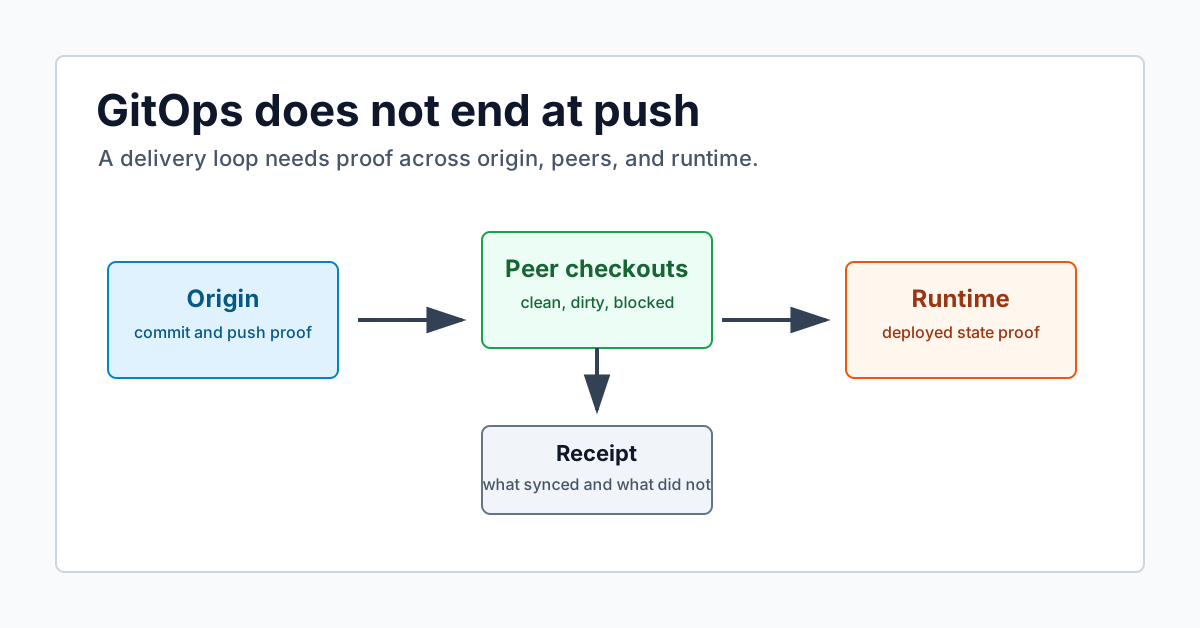
GitOps usually focuses on the central repository: commit, pull, push, deploy. In an agent-heavy workflow, that is not the whole loop.
The same project may be open on a laptop, a remote workstation, and one or more server-side agent lanes. Each machine can have local context, pending edits, mirrors, timers, runtime processes, or an agent session that will resume later. If origin moves and the peers do not, the next agent may start from stale code while everyone believes the system is current.
That is why git push is only a proof of intent. It proves the remote accepted a commit. It does not prove the relevant working surfaces, runtime checkouts, services, or review mirrors are now using that commit.
GitOps fanout is the boring fix: after a clean push, ask known peer checkouts to fast-forward when it is safe, and report the ones that cannot.
Push Is Not Delivery Proof
The expensive bug is not always broken code. Sometimes the expensive bug is believing a fix is live when it never reached the place that runs.
In small systems this happens more often than people admit:
- a service runs from a different checkout than the one just pushed
- a peer machine has local edits and cannot safely pull
- a remote mirror is behind origin
- a timer or process is still using an old virtual environment or build output
- a public endpoint is backed by a different deployment path
- an agent resumes in an old working tree and starts from stale assumptions
None of these are solved by a nice commit message. They are solved by readback.
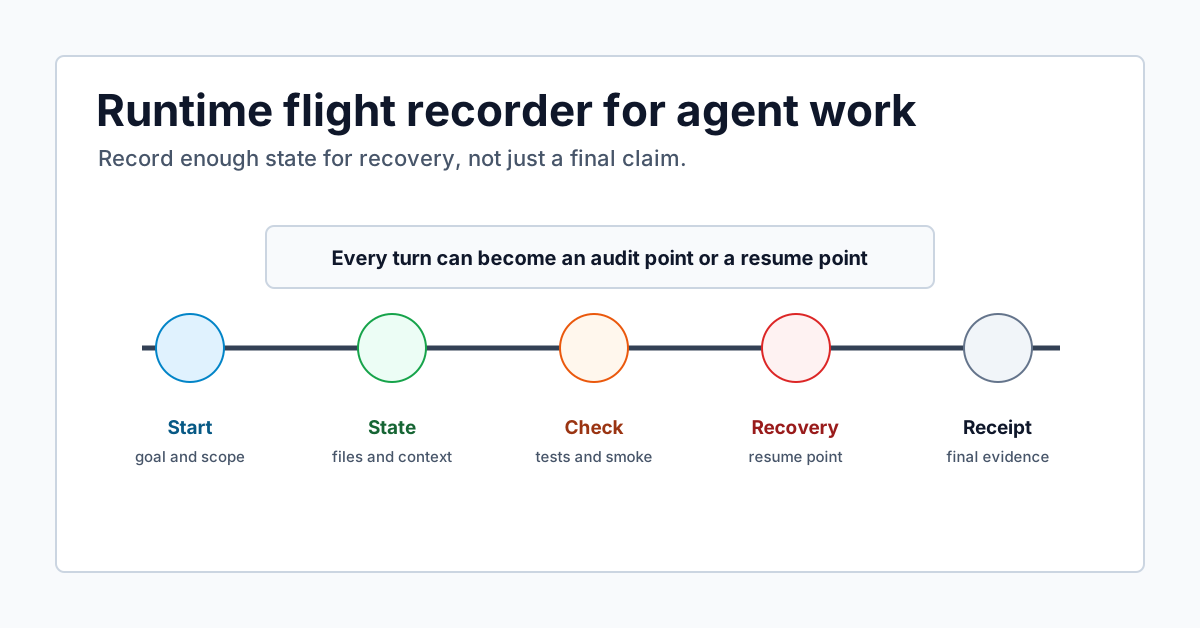
The delivery proof chain is:
origin proof -> host proof -> runtime proof.
Origin proof says the remote has the commit. Host proof says the target checkout has the commit. Runtime proof says the surface that matters is actually using it or has been reloaded, rebuilt, or smoke-tested as needed.
The Safe Fanout Contract
The important part of fanout is restraint.
A fanout rail should not act like a hero. It should not stash someone’s work, rebase a peer, reset a checkout, clean untracked files, or overwrite local changes just to make the dashboard green. That creates a coordination system nobody can trust.
A safe fanout rail should only do the operation that is obviously safe:
- identify the expected peer checkout
- confirm it is on the expected branch
- confirm the tracked worktree is clean
- fetch the remote state
- fast-forward only
- record the result
- report dirty, diverged, missing, or unreachable peers without mutating them
This turns “I pushed” into a more useful statement: “the working surfaces are either current or explicitly known to be out of sync.”
That second half matters. A blocked peer is not a failure to hide. It is a state to expose.
Why Agents Need This
Humans are already bad at remembering where every checkout lives. Agents make the problem worse because they can run in more places and resume from older context.
An agent may correctly change a file, commit it, push it, and still leave the operator with a stale server-side session. Another agent may wake up later in a different checkout and reintroduce the old assumption. A third may inspect the wrong runtime path and “verify” a system that is not actually serving the change.
Fanout does not solve all of that. It creates a simple reliability layer around the part that Git can safely own.
The rule is: never pretend synchronization happened. Prove it, or name the blocker.
Runtime Readback
For pure source changes, fast-forwarding peers may be enough. For runtime systems, the fanout loop should continue into readback:
- which checkout is the process using?
- does the service need reload or restart?
- did the timer or worker pick up the new code?
- does a healthcheck or smoke test show the expected behavior?
- was the evidence recorded somewhere another operator can inspect?
This is where GitOps stops being a slogan and becomes a delivery contract.
The point is not to build a complex platform for every small project. The point is to remove ambiguity at the handoff boundary. If a human or agent says “done,” the next person should be able to see whether the code reached the surfaces that matter.
The Practical Standard
For multi-machine agent workflows, my preferred closeout is:
- commit exists locally
- remote contains the commit
- known clean peer checkouts fast-forwarded
- blocked peers are listed with the reason
- runtime surfaces were reloaded or explicitly left out of scope
- a focused smoke or healthcheck ran when behavior changed
This is not glamorous infrastructure. It is the operational layer that prevents stale starts and false closure.
GitOps does not end at push. In an agentic workflow, push starts the delivery proof.
Reader next step
Keep reading before switching into hiring mode.
Related posts and tags are the natural continuation. About gives the profile context, and Projects has a few implementation notes.