Stop sending people into a two-hour podcast
Long-form context is valuable, but onboarding needs a smaller package people can actually use.
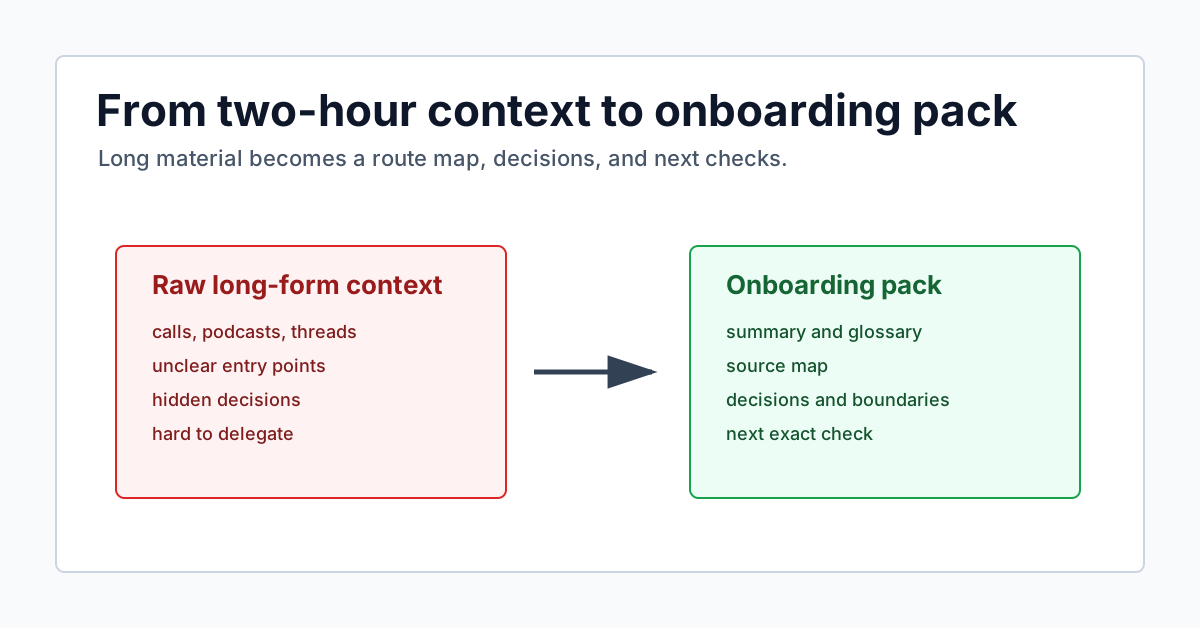
Long recordings are often the richest source of context and the worst onboarding surface.
That is the pattern I ran into with OpenClaw. A person asks a practical question like, “What is this tool, and how should I approach it?” The available context may be real and useful: a long interview, scattered docs, a thread of product notes, a few examples, and a community conversation. But the default answer becomes: watch the whole thing, read around, and connect the dots yourself.
That is expensive. It is also a sign that the knowledge system is pushing the work onto the next person. The recording can remain evidence, but it should not be the entrypoint.
The better unit is an onboarding pack: a compact artifact that gives a person or agent the first useful mental model without pretending the source material does not exist.
An onboarding pack is not a replacement for the original call, transcript, or docs. It is a front door. It tells the reader what the thing is, why it matters, what has already been decided, what is still unknown, and where to inspect the source if they need to challenge a point.
This matters even more for agentic work because a model can ingest a transcript without truly understanding the task boundary. Long context does not automatically become a usable brief. It can become a soft prompt where goals, constraints, side comments, decisions, and speculation all sit at the same level. That is how an agent starts sounding informed while still working on the wrong problem.
A useful onboarding pack separates layers:
- the short summary gives orientation;
- the decision list shows what is current;
- the glossary translates local names and terms;
- the source links preserve the evidence trail;
- the open questions show what should not be assumed;
- the next action gives the reader a way to start.
The source material still matters. In the OpenClaw example, the interview and concept docs were useful because they held the richer context. The practical move was to add a question-answer layer on top, so a reader could ask targeted questions instead of being forced through a two-hour linear path.
That is small systems work, but it changes the user experience. It reduces the distance between raw material and first understanding. It also makes the onboarding surface reusable. Instead of explaining the same thing from scratch, you can point to the pack, then improve the pack when a new confusion pattern appears.
There is a useful discipline here: do not turn the pack into another giant document. The pack should be short enough to scan and structured enough to trust. If it becomes a second transcript, it has failed. If it removes all nuance and hides the source, it has also failed.
The practical check I use is simple. Can a new person or agent answer these questions after reading the pack?
- What is this tool or project?
- Why is it relevant now?
- What is the first useful mental model?
- What should I not assume?
- Where is the source material?
- What is the next action I can take without re-listening to everything?
If the answer is yes, the long-form context has been converted into an operating surface. If the answer is no, the team is still asking every new reader to pay the full context tax.
Good onboarding does not mean deleting depth. It means making depth reachable.
That is the useful lesson beyond OpenClaw. Many fast-moving technical products already have enough raw information. What they lack is a small, trustworthy route from confusion to first useful action. Building that route is product work, developer education, and systems design at the same time.
Reader next step
Keep reading before switching into hiring mode.
Related posts and tags are the natural continuation. About gives the profile context, and Projects has a few implementation notes.