MetaClaw after the demo
Why continuous adaptation is an operator problem, not only a model capability.
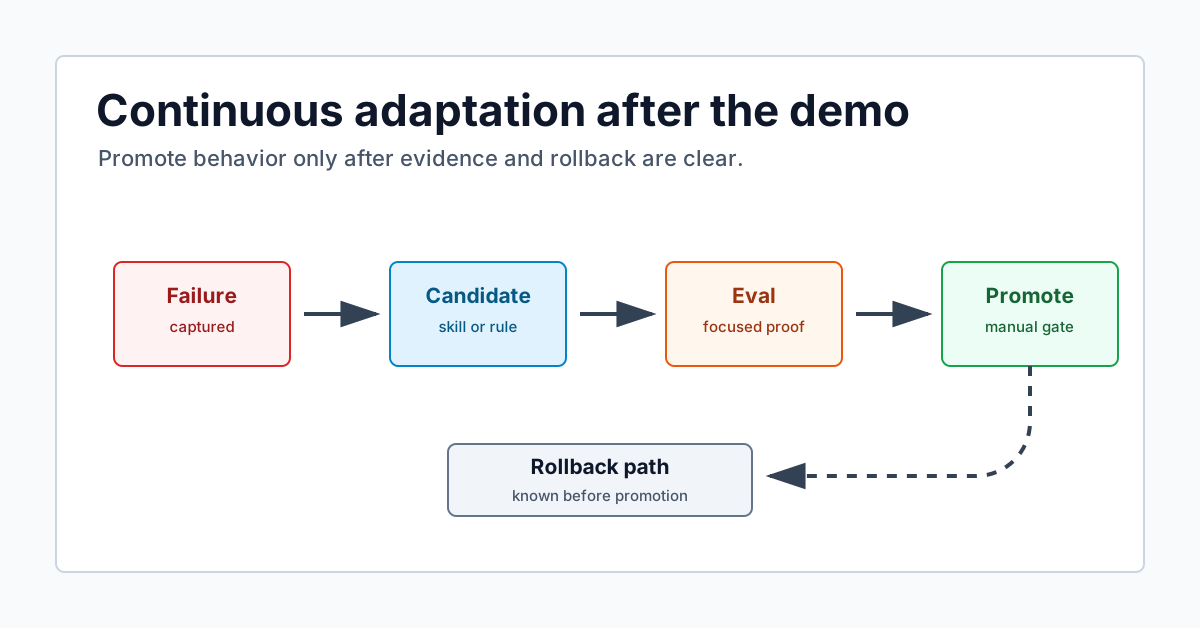
The interesting part of an adaptive agent system is not the first demo.
A demo shows whether an agent can follow a path once, under conditions that were chosen for the demo. Real work starts when the path changes: the repo moves, the checklist becomes stale, the operator cares about a different constraint, or a failure class appears twice in a row. At that point, “the model can adapt” is not a sufficient answer. The practical question is: how do you improve behavior without turning live work into the experiment?
That is the part of MetaClaw I find useful. The public conversation around continuous adaptation often jumps quickly to reinforcement learning, fine-tuning, self-improving agents, and other heavy model-side stories. Those may matter, but they are not the first layer I want in a production workflow. The first layer should be faster, cheaper, and reversible.
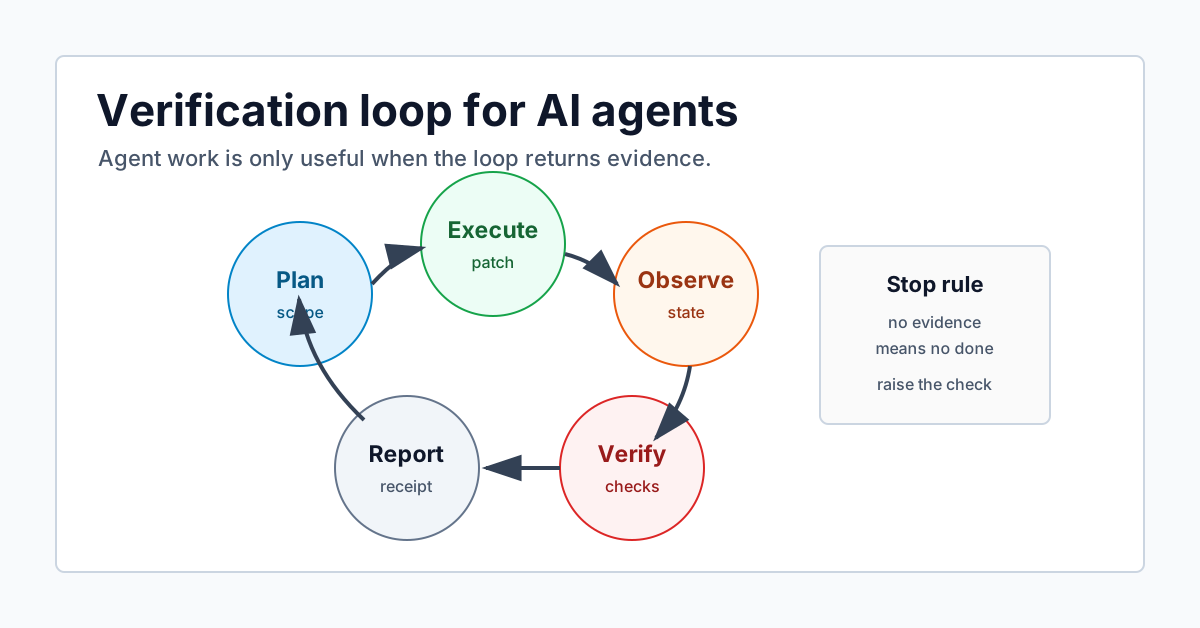
The safer loop is closer to:
capture failure -> candidate skill -> eval -> manual promote
It is not:
the agent failed -> let it retrain itself
That distinction sounds small, but it changes the whole operating model. In the first loop, adaptation is an engineering process. A repeated failure becomes a candidate skill, routing rule, checklist patch, eval case, or procedural change. The operator can inspect it, run it against a small evaluation pack, promote it, and roll it back if it creates new damage. In the second loop, adaptation becomes a story about the agent changing itself, which is much harder to observe and much easier to mistake for progress.
I think useful adaptation needs at least two layers.
The fast layer changes behavior around the model. It can update skills, prompts, tool descriptions, routing rules, handoff requirements, decision records, or verification gates. This is where most teams should start because it is inspectable and cheap to reverse.
The heavy layer changes the model or learned behavior more directly. That can be valuable, but it should not be the default response to every workflow failure. If the agent is reading the wrong source of truth, skipping a verification step, or confusing a stale board with the current task, retraining is not the boring fix. The boring fix is to repair the operator loop.
This is where many “self-improvement” stories fail in practice. They describe a capability without the surrounding system needed to keep it honest. A real runtime needs history, telemetry, failure normalization, small evals, explicit promotion, and rollback discipline. Without those pieces, it is easy to say the agent is improving when it is really just drifting into a new shape.
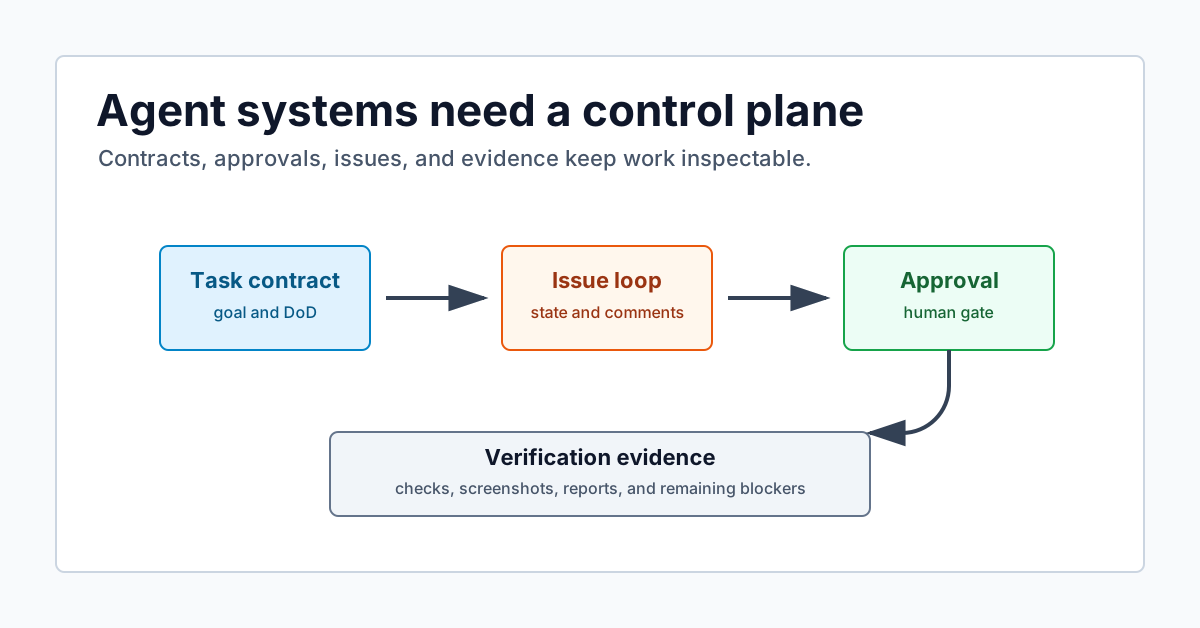
The practical control surface is not glamorous. It should answer a few questions every time behavior changes:
- What failure did we observe?
- Is it a one-off issue or a repeated class?
- What small behavior patch would reduce it?
- Which eval or manual check proves the patch helped?
- Who promoted it?
- How do we roll it back?
Those questions keep adaptation grounded in the work instead of in a fantasy of autonomous evolution. They also protect the team from the opposite failure mode: adding more prompts, more docs, more dashboards, and more reminders while the agent still cannot tell which instruction is live right now.
For me, MetaClaw is less about one perfect adaptation mechanism and more about the boundary between reversible behavior adaptation and heavier model adaptation. I want the agent system to learn from failure, but I want the learning path to be safe, observable, and owned by an operator.
The first demo proves a system can perform once. Continuous adaptation proves whether it can keep working after the first surprise.
Reader next step
Keep reading before switching into hiring mode.
Related posts and tags are the natural continuation. About gives the profile context, and Projects has a few implementation notes.