Making quota limits visible in product
Quota limits should be visible product behavior, not a surprise runtime failure.
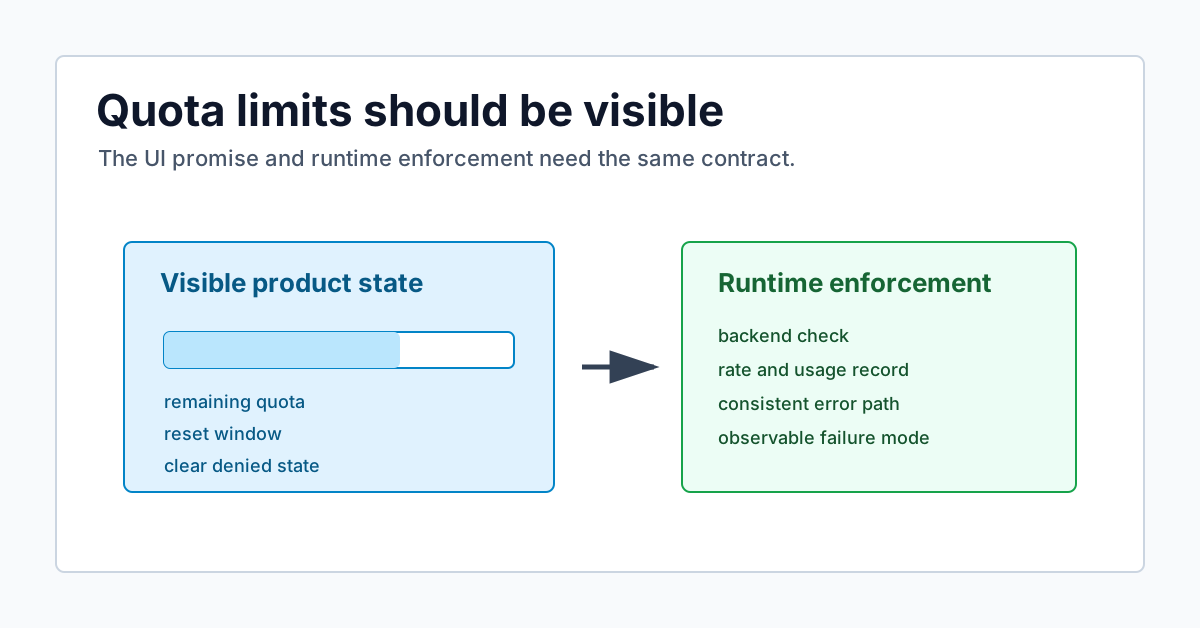
Quota limits are usually implemented as backend rules first. That is understandable, but it is not enough.
If a user only learns about a quota when an action fails, the product has turned a predictable constraint into a runtime surprise. The system may be technically correct and still feel broken.
I worked on one version of this problem in a workspace product where quota state needed to become visible in the interface and enforced in live chat behavior. The important part was not “add a limit.” The important part was making the UI and runtime agree.
That distinction matters because quota failures are not only backend events. They are product moments. A user has intent, clicks a button, expects work to happen, and receives either a clear explanation or a vague failure. If the product gives no warning until the last second, support inherits the ambiguity and engineering inherits the drift between what the UI implied and what the backend allowed.
The better pattern is to make quota part of the product language.
The user should be able to see the relevant limit before they hit it. They should understand what is included in the count. When an action is no longer available, the product should show that state deliberately instead of letting the user discover it through failure. If the product has subscription settings, workspace usage belongs there in plain language.
The runtime still needs to enforce the rule. UI checks can be stale, bypassed, or wrong. In a chat product, for example, the live send path needs its own guardrail. If new writes are blocked because the workspace is over quota, the WebSocket or API boundary should enforce the same rule the UI already communicated.
That gives the system two layers:
- visibility before the user acts;
- enforcement when the action reaches the runtime.
The layers should not compete. Visibility without enforcement is a promise the backend may not keep. Enforcement without visibility feels arbitrary. Together, they make the product more honest.
This is especially important for AI and automation products because one user action can trigger many background calls. The operator may understand the cost model, but the user sees one button. If the button sometimes works and sometimes does not, the product owes them a clear reason.
The implementation details are usually less glamorous than the architecture diagram. You need to decide which quota is shown, where it is shown, what happens at the threshold, which actions are disabled, what message explains the block, and which runtime path enforces it. You also need enough logging or evidence for support and engineering to explain what happened later.
The sequencing matters. If the backend rule ships first and the UI follows later, the product may spend a while in a state where the system is protected but the user experience is confusing. If the UI ships first without runtime enforcement, the product can imply guarantees the system does not actually defend. The work is finished only when both layers describe the same rule.
A practical checklist looks like this:
- Is the limit visible in the place where users make plan or workspace decisions?
- Does the copy explain what the limit includes?
- Are blocked actions visibly different from available actions?
- Does the live API or socket path enforce the same rule?
- Do tests cover both the visible state and the runtime guardrail?
- Can support tell whether the quota block was expected behavior?
The last question is easy to ignore, but it is where product quality often shows up. A quota rule is not finished when the database says no. It is finished when the user can understand the state, the runtime can defend the state, and the team can explain the state without guesswork.
Good systems work often looks like this: product behavior and backend reality stop drifting apart.
That is why I like this pattern as a signal of platform maturity. It is not only a quota feature. It is a small proof that the product, API boundary, and support story can share one operational truth.
Reader next step
Keep reading before switching into hiring mode.
Related posts and tags are the natural continuation. About gives the profile context, and Projects has a few implementation notes.